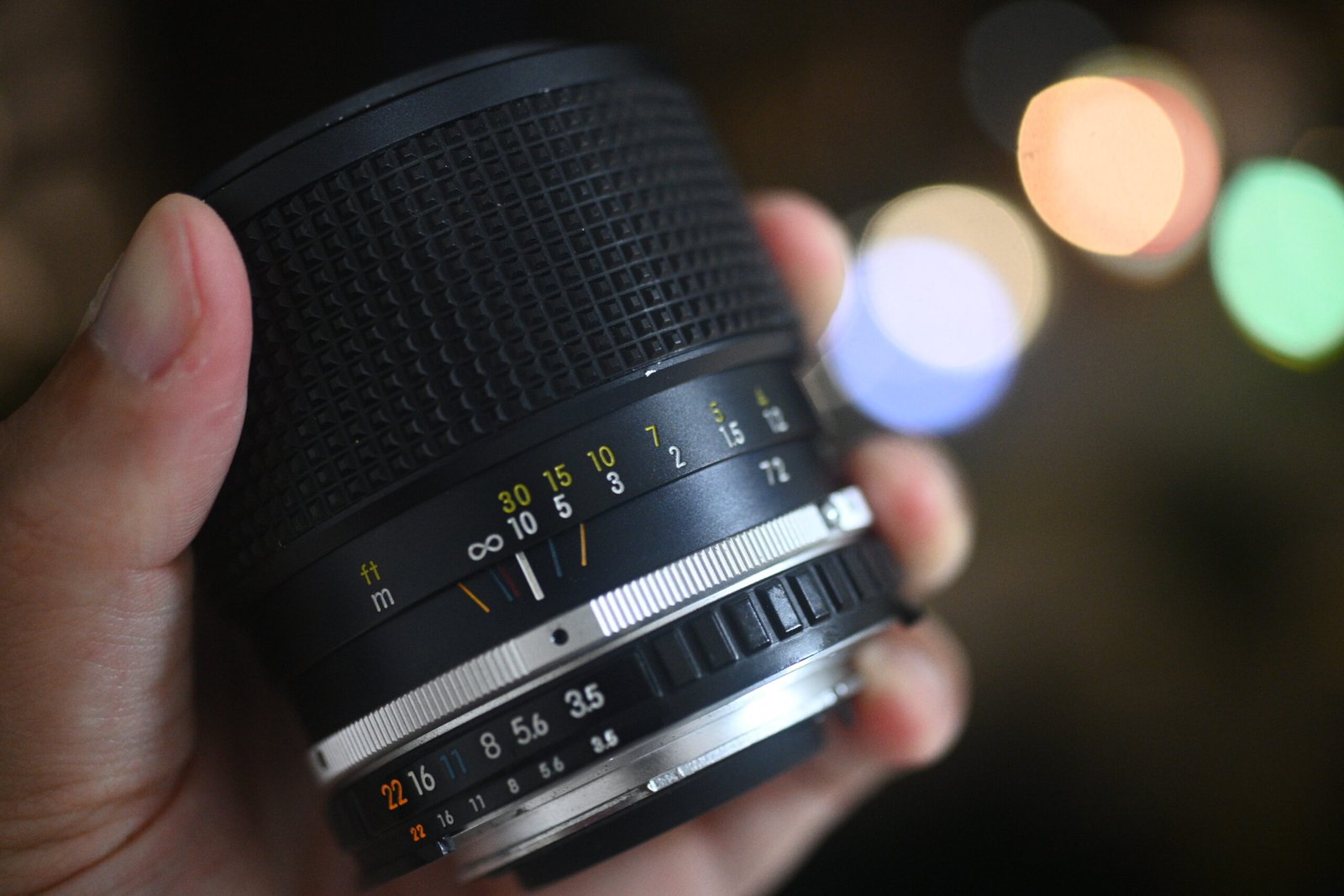
In the world of vintage Nikon glass, there are legends, and then there are the “infamous” ones. If you’ve spent any time researching vintage zooms, you’ve likely heard of the Zoom-Nikkor 43-86mm f/3.5.
It was Nikon’s first mass-market zoom, and while it was a bestseller, it also earned a reputation for being one of the “worst” lenses Nikon ever made due to its heavy distortion and flare.
But what if I told you that Nikon quietly fixed everything that was wrong with the 43-86mm, wrapped it in a sleek, compact body, and sold it under a different name?
Enter the Nikon Series E 36-72mm f/3.5.
Released in 1981 alongside the Nikon EM, this lens was part of the “Series E” line, Nikon’s first attempt at a budget-friendly consumer range. For years, “Series E” was a dirty word among pros who preferred the all-metal construction of the AI-S Nikkors.
But in 2026, as we look for character, value, and portability, this little zoom is finally getting the respect it deserves.
I picked up a mint copy for just SG$15 from the junk bin in a Book Off (used items store) in Japan. After some time trying the lens, I’m believe this is one of the best budget lenses in the Nikon F-mount universe.
*all the shots taken here are on the Nikon Z7II at medium jpeg settings, no extra sharpening.
1. The Series E Philosophy: Cost-Cutting or Genius?
To understand the 36-72mm, you have to understand the Series E philosophy. In the late 70s, Nikon wanted to capture the amateur market. To keep prices low, they made three key changes:
1. Materials: They used high-quality plastics for some external parts (though the 36-72mm is surprisingly metal-heavy).
2. Branding: They dropped the “Nikkor” name, simply calling them “Nikon Lens Series E.”
3. Simplicity: They focused on simple, effective optical designs.
The 36-72mm f/3.5 was designed by Satoshi Mogami, a legendary theorist at Nikon who also worked on the AI Nikkor 24mm f/2. His goal was to create a “legitimate successor” to the 43-86mm that was sharper, wider, and more reliable.
Image Suggestion: A “hero” shot of the Nikon Series E 36-72mm f/3.5 mounted on a compact body like the Nikon EM or a Nikon FE2. The lens should look sleek and proportional to the small camera body.
2. Build Quality and Handling: The “Push-Pull” Experience
The first thing you’ll notice about the 36-72mm is its size. It’s tiny. It uses 52mm filters, which is the standard for almost all classic Nikon primes. This means you can share filters between this zoom and your 50mm f/1.8 or 28mm f/2.8.
The One-Touch Design

This is a “one-touch” or push-pull zoom. You slide the ring forward to zoom in to 72mm and pull it back for 36mm. The same ring also handles the focusing.


•The Good: It’s incredibly fast to use. You can zoom and focus simultaneously, which is great for street photography.
•The Bad: “Zoom Creep.” Because these lenses are 40+ years old, the internal friction felt often wears out. If you point the lens down, it might slide to 72mm on its own. Your mileage may vary depending on your own copy. My copy doesn’t have any zoom creep.
Another issue is that the zoom action actually pushes air. You can feel it when pushing and pulling with the lens unmounted. Not a big problem except when you are in dusty environments.
Construction
Despite being a “budget” lens, the 36-72mm feels remarkably solid. The mount is metal, and the barrel has a high-quality finish that doesn’t feel “cheap” like modern kit lenses. It has a tactile, mechanical soul that you just don’t get with modern plastic zooms.
3. Optical Performance: Sharpness and Character
The 36-72mm features an 8-element in 8-group design. Unlike its predecessor, it uses modern coatings (Nikon Integrated Coating or NIC) which significantly improve contrast and flare resistance.
Sharpness

At f/3.5, the lens is “vintage sharp.” It’s not going to out-resolve a modern Z-mount prime, but it has plenty of detail for 24MP sensors. The center is excellent, while the corners are a bit soft at 36mm.

By onwards f/5.6, this lens becomes a different beast. It’s much sharp across the frame. I will use it for landscape shots, no problem.
Constant Aperture

One of the biggest selling points is the constant f/3.5 aperture. Most modern “kit” zooms are variable (f/3.5-5.6), meaning they get darker as you zoom in. Having a constant f/3.5 at 72mm is a huge advantage for portraits, giving you decent subject separation and a consistent exposure.

Distortion and Flare


Nikon fixed the distortion issues of the previous 43-86mm. There is some barrel distortion at 36mm and on the 72mm side, you get some pin cushion distortion. Both are easily corrected in Lightroom.
Flare resistance is surprisingly good for a lens of this era. You’ll get some “ghosting” if you shoot directly into the sun, but it’s often a pleasing, cinematic flare rather than a messy one.
4. The “Series E” Secret: Why 36-72mm?

You might wonder why Nikon chose such an odd range. Why not 35-70mm?
The rumor in the collector community is that this lens is actually a 35-70mm, but Nikon rebadged it as 36-72mm to avoid competing with their much more expensive 35-70mm f/3.5 AI lens. By shifting the numbers slightly, they could market it as a “different” product for the consumer line.

Whatever the reason, the 2x zoom range is perfect for a “walk-around” lens. 36mm is wide enough for most street scenes, and 72mm is a decent portrait focal length.
5. Adapting to Mirrorless: A New Lease on Life

If you’re a mirrorless Z Mount shooter, this lens becomes much easier to use.
•Focus Peaking: Manual focusing a push-pull zoom is much easier with focus peaking.
•IBIS: With In-Body Image Stabilization, you can shoot this lens at 72mm at shutter speeds as low as 1/30s (tested, but some shakiness remains).
•Video: The constant f/3.5 aperture and somewhat smooth manual focus (mine was from a junk bin so not as smooth, but with servicing i’m sure it will get much better) make it a great “vintage” lens for video creators looking for a nostalgic look.
6. Nikon Series E 36-72mm vs. The Competition
How does it stack up against other vintage zooms?
| Lens | Max Aperture | Filter Size | Weight | Character |
| Series E 36-72mm | f/3.5 (Constant) | 52mm | 380g | Sharp, compact, great value |
| Nikkor 43-86mm | f/3.5 (Constant) | 52mm | 410g | Heavy distortion, “lo-fi” look |
| Nikkor 35-70mm f/3.5 AI | f/3.5 (Constant) | 72mm | 510g | Pro-build, very sharp, bulky |
| Series E 75-150mm | f/3.5 (Constant) | 52mm | 520g | Legendary sharpness, portrait king |
While the Series E 75-150mm was the “superstar” of the Series E line, the 36-72mm is its perfect companion. Together, they cover almost everything you need for a travel kit. Nowadays, you can cover it with any cheap zoom. I personally have the Nikkor Q.C. 200mm f/4.
7. Conclusion: The Budget Photographer’s Best Friend

The Nikon Series E 36-72mm f/3.5 is the definition of a “bargain.” For less than the price of a CF Express memory card (more than a $100 last I checked in 2026), you get a constant-aperture zoom that is compact, sharp, and full of character.
It’s not a lens for everyone. If you need autofocus or clinical perfection, look elsewhere. But if you enjoy the tactile feel of manual focus, the “one-touch” zoom experience, and the unique look of vintage glass, this lens is a must-have.
It’s the lens that fixed the mistakes of the past and proved that “budget” doesn’t have to mean “bad.” If you see one for under SG$60, don’t think—just buy it. You won’t regret it.
PS.
I also talk about other classic lenses like the Nikon AF-S 300mm f/4D. For another old lens, check out the Nikkor 200mm Q.C. f/4 and the Sigma 50mm Macro 2.8.
Leave a Reply