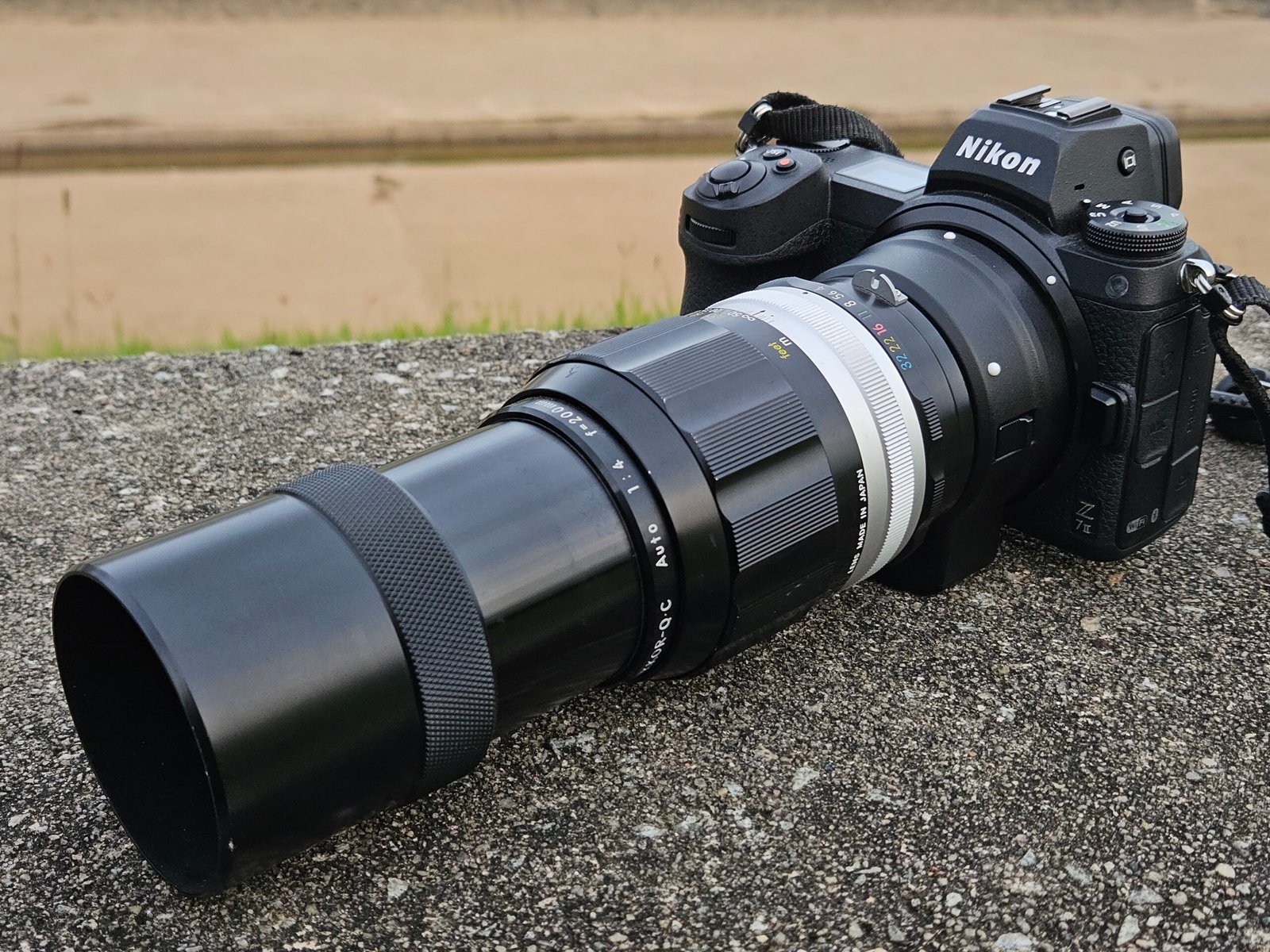
If you’ve been browsing the used camera shops in Peninsula Plaza or scrolling through Carousell lately, you might have spotted a long, slender, all-metal lens with a distinctive silver ring. That, my friends, is the Nikkor-Q 200mm f/4 Auto.
Released in 1961 (and in active sales through 1975), this was Nikon’s first “portable” 200mm telephoto lens for the F-mount. Back then, it was a professional tool used by photojournalists and sports photographers.
Today, it’s often dismissed as a “dinosaur” because it lacks autofocus, image stabilization, and even AI-coupling (in its original form).
But here’s the kicker: you can often find these for under SG$80. I bought a beaten up copy of the lens in Japan for SG$15. After spending a few weeks adapting this 60-year-old relic to my modern mirrorless setup (the Nikon Z7II), I’ve discovered that this “dinosaur” still has plenty of bite.
Build Quality: They Truly Don’t Make Them Like This Anymore

The first thing you notice when you pick up the Nikkor-Q 200mm f/4 is the weight. At roughly 630g, it’s not a featherweight, but it’s surprisingly slim. The construction is entirely metal and glass, no plastic to be found here (they don’t make em like they used to). The lens itself is not that big, you can see the Nikon 50mm S beside it for scale.
The Built-in Hood

One of my favorite features is the built-in telescoping lens hood. It’s made of solid metal and slides out with a satisfying “clunk”. The image above shows the lens with the hood slid out.
In an era where we have to pay extra for plastic hoods or worry about losing them, this integrated design is nice and convenient.

The Focus Ring
The focus throw on this lens is long, nearly 270 degrees. This makes it incredibly precise for manual focusing, which is essential when you’re shooting at 200mm. The relatively thick focus ring area also helps, with the added textures as well. The dampening on my copy was still smooth enough though it could do with a little oiling via servicing.
Optical Performance: The “Q” Stands for Quality (and Four)
The “Q” in Nikkor-Q stands for Quattuor, Latin for four, referring to its 4-element in 4-group optical design. It’s a simple, elegant construction that yields surprisingly good results.
Sharpness


At f/4, the lens is respectably sharp in the center, though it has a bit of “vintage glow” (slight spherical aberration) that lowers the contrast. By f/5.6 and beyond, it sharpens up significantly. For landscape photographers on a budget, this is a fantastic performer.
Color and Contrast

Being a single-coated lens (unless you find the later “C” multi-coated version), the contrast is lower than modern lenses. However, this gives the images a beautiful, organic look that many photographers find more “soulful” than the clinical perfection of modern glass. The colors are slightly warm, which I personally love for golden hour shots.
Bokeh


With only 6 diaphragm blades, you might expect the bokeh to be busy. However, because it’s a 200mm lens, at f/4, the background compression is so strong that the out-of-focus areas usually melt away into a smooth, creamy wash. It’s a lovely lens for isolating subjects in a busy street or park.
The Compatibility Catch: Non-AI vs. AI-Converted
Before you rush out to buy one, there’s a major caveat for DSLR users. The Nikkor-Q is a Non-AI (Pre-AI) lens.
•On Modern DSLRs (D7000, D850, etc.): You cannot mount this lens directly without damaging the aperture indexing tab on your camera. You must either have it “AI-converted” (milled down) or use a lower-end body like the D3000/D5000 series (which lacks the tab).

•On Mirrorless (Nikon Z): This is where the lens truly shines. With the FTZ adapter (either version 1 or 2 is fine), you can mount this lens on any mirrorless body. Since mirrorless cameras use focus peaking and EVF magnification, manual focusing a 200mm lens becomes much easier.
I personally use the red peaking to check for focusing. Otherwise, I use the function button (custom setting) beside the grip to do a quick, magnified check.
Real-World Usage: The Manual 200mm Challenge
Shooting with a manual 200mm lens in 2025 is a lesson in patience. Even with in body stabilisation (IBIS), you need to keep your shutter speeds high, ideally 1/200s or faster, to avoid camera shake. On a DSLR or bodies without IBIS, you need a faster shutter speed and manual focusing becomes more difficult as well.
I took the Nikkor-Q to my nearby neighbourhood park for some nature photography. While I missed some fast-moving shots that a modern AF lens would have nailed, the shots I did get had a unique character. The way it renders the image and the soft transition to the background is something special.
Here are some images from my walkaround:


Nikkor-Q 200mm f/4 pricing in 2026

If you are based in the US, you can get some pretty good deals on the lens assuming you’re not caught in a bidding war.

For those based in Singapore like me, we can get the lens at between SG$80-$125 in 2026.
Nikkor-Q 200mm f/4 in 2025: Who is it for?
Is this 60-year-old lens still a good buy?
Yes, if:
•You are a Mirrorless User: It’s one of the cheapest ways to get a high-quality 200mm prime.
•You Love the “Vintage Look”: The lower contrast and warm colors are perfect for creative portraits and landscapes.
•You Appreciate Build Quality: It’s a tactile joy to use a lens that feels like a precision instrument.
No, if:
•You Need Speed: Manual focus at 200mm is not for sports or erratic wildlife.
•You Shoot on a High-End Nikon DSLR: Unless it’s already AI-converted, you risk damaging your camera.
•You Want “Clinical” Perfection: If you hate flare and want maximum contrast wide open, stick to modern zooms.
Conclusion
The Nikkor-Q 200mm f/4 is a reminder that great glass doesn’t have an expiration date. For the price of a few cups of coffee, you get a professional-grade telephoto lens that can still produce stunning, gallery-quality images today. It’s not the easiest lens to use, but the rewards are well worth the effort.
If you see one in a display case, don’t walk past it. Pick it up, feel the weight, and give it a try. You might just fall in love with the “Q.”
I also talk about another classic telephotos like the Nikon AF-S 300mm f/4D. For another old lens, check out the Sigma 50mm Macro 2.8.
Personal Plug by Chris Puan
If you enjoy my blog content, please consider supporting the website by buying me a coffee here. Thanks for your support! 😀
Leave a Reply