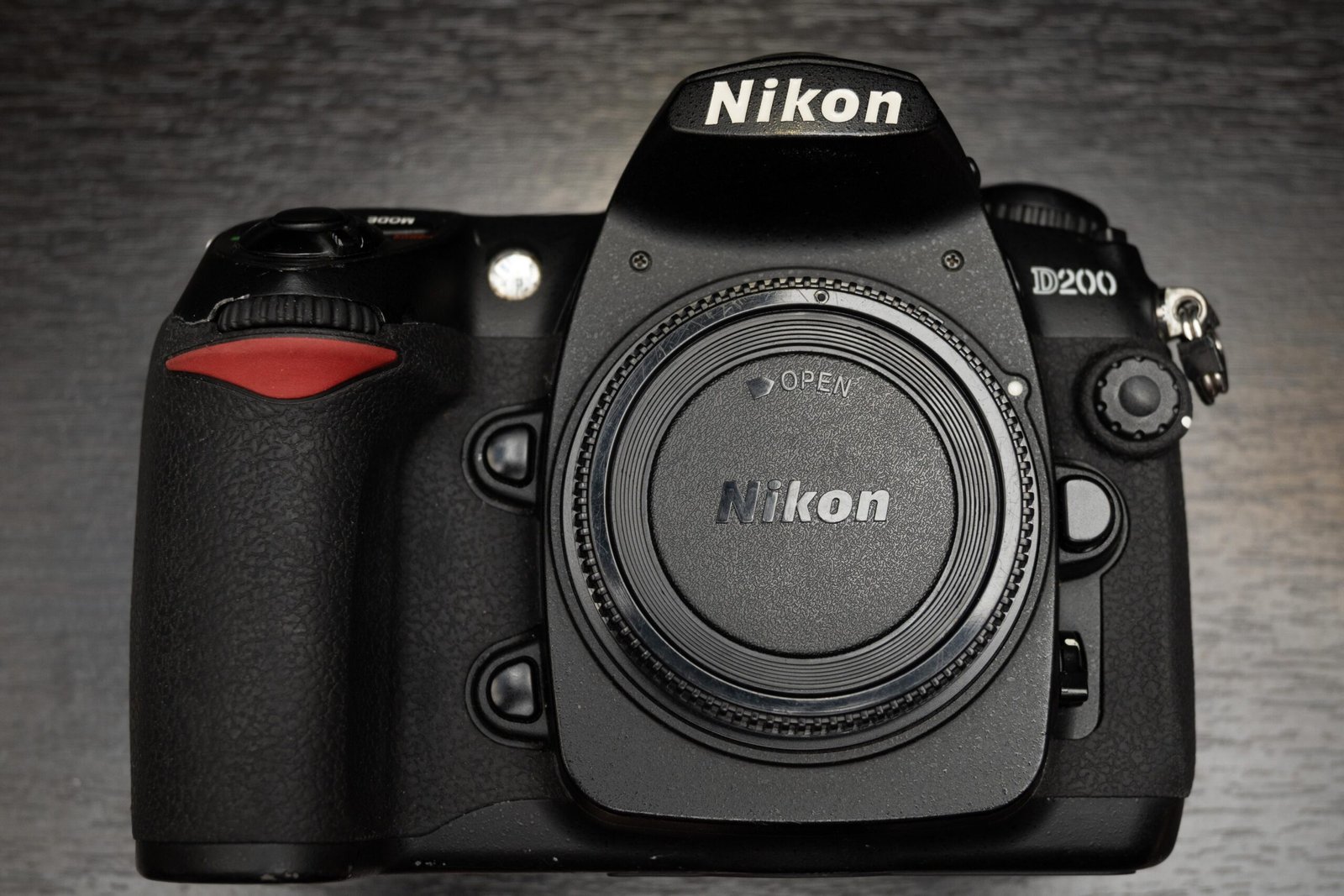
The Nikon D200 was released in 2005, back when digital photography was still in it’s nascent stages and film was still reigning. The professional grade D1, D1X and D1H have already been released on the Nikon roster alongside the Nikon F5 (film pro grade body).
According to DPRreview, the D100 (my thoughts on the D100 here) started a new camera segment in the under $2000 USD range, and was a game changer as it made enthusiast grade DSLRs approachable for professionals and enthusiasts alike. The D200 looked to continue that trend.
Now, in 2021, about 15 years after it’s entry into the market, I wanted to revisit it to see how the camera has aged over the years. I’m certainly not going to change my primary camera (Nikon Z6 Mark I) to the D200, but it would be an interesting look at how far camera tech advances have progressed since the early 2000s.
Ergonomics of the D200
In hand, the grip immediately feels familiar to anyone who has used a Nikon DSLR in the last 10 years. Instead of the straight, film camera like grip from the D100, we now have the curved grip. Looking at the camera as a whole, it definitely looks as though the D200 would set the tone for the rest of the its descendants to come.
The camera is weighty, but I would describe it as a reassuring heft rather than simply heavy. The entire chassis inspires confidence, though people who have since moved on to mirrorless, like me, will feel the additional weight after a few hours.
The D200’s top left dial

The now familiar top left dial used commonly in pro grade Nikon DSLRs is used in the D200, as compared to the older dial format used in the D100. Having shot tens of thousands of shots with Nikon Pro grade bodies from D3 onwards, my muscle memory did not fail me and I was able to use the D200 quite smoothly to change my settings.
The D200 Back LCD

The bigger rear LCD panel is a welcome change compared to the tiny one on the D100. I could comfortably check my shots on the panel. Color accuracy and portrayal was also no longer an issue. The only complaint I had was that the panel itself wasn’t very high resolution. Trying to zoom in to check critical sharpness was not useful. The display size and resolution upgrade came eventually in the D300.
D200 Top LCD

The top LCD panels show the shooting information such as ISO, shutter speed and aperture settings, as well as the number of shots remaining if you need it. The large panel is welcome since all the information is laid out clearly and easy to see.
Nikon D200 Menus
The familiar custom menus have appeared here, and most modern Nikon users will be right at home using these menus, a massive upgrade from the archaic menus in the D100. There are quite a few custom functions to be used here as well, controlling the AF system, the playback and shooting as well.
Nikon D200 Buttons Layout
You may have noticed already, but the 2 button card formatting short cut had already been implemented in the D200 (one of the buttons is the mode button as shown in the picture above, with the red text beside it).
This is definitely one of the functions in Nikon DSLRs that I personally found useful, since it allows me to quickly format and prepare my storage cards before a shoot instead of going through a series of menus to do so. The current batch of mirrorless cameras do not have this shortcut (i mapped it to function buttons myself.)

On the back of the D200, 2 important levers stand out. The lever controlling the release of the CF card slot and other controlling the AF system, whether it be single AF point or the very intuitive group AF point detection, which I found in practice to be rather accurate for tracking large subjects.
Card slot

The card slot remains a single CF card slot, but the position has now been shifted to the now familiar right side of the camera, with the release button there as well. The slot is opened from the lever at the back, visible in the top left of the picture.
There is built in weather sealing, with rubber gaskets around the card slot to prevent or slow entry of water.
Sensor/ Image quality on the Nikon D200 (CCD Sensor)

As I mentioned in the D100, sensor tech has advanced rapidly over the years. A sensor from 15 years ago, even one that is of APS-C size, can barely keep up even with smartphone cameras, especially those from high end phones such as iPhone Maxes and the Samsung S2xs with optimised software and hardware.
With social media recently, there has been a surge in popularity of CCD sensor cameras. The colors of the CCD sensor here is indeed different from a CMOS. I can’t describe it well, but there is a certain “look” to the images (maybe it’s my imagination though).
With a decent prime lens like the Nikon AF-S 50mm 1.4G, however, one can still get some pretty good pictures that are sufficient for small prints and smartphone screens.
Nikon D200 Resolution
The D200 CCD sensor offers only about 10.2MP, nothing much to shout about now, but back in 2005 this was pretty much state of the art. At this MP count, one can expect to print images of 13 by 9 inches ( 1inch = 2.54 cm) at 300ppi. This means we could print A4 sizes comfortably.
Image quality comparisons
During shooting, I noticed that the ISO options in the D200 are leaning more towards the exposing brighter situations compared to the D100, given that the base ISO has been reduced to 100 instead of 200 and the maximum ISO (Hi-1) is now only 3200 instead of the D6400 in the D100.


At base ISO up to ISO 400, I would have no issues with image quality. After 800, though, the grain starts becoming more prominent. At Hi 1 (ISO 3200), the image is extremely grainy and there is reddish/ purple color noise in the dark areas. As you can see from the comparison above, there is a yellowish/reddish tinge to the image shot at ISO 3200.
I won’t say the image is rubbish, but if you zoom in, the image falls apart.
Dynamic Range

The image above was adjusted in Lightroom and had shadows boosted and highlights recovered. Apologies for the lacklustre sunset image but I was more interested in testing the sensor of the camera. Shooting in raw at base ISOs yield very decent image quality with good dynamic range. Definitely useable even by 2021 standards.
The D200’s Autofocus

The D200 uses the 11 point Multi cam 1000 which was later used for more than a decade even until the D3500. Whether Nikon made improvements on the module over the years remains to be seen. The AF system worked reasonable well during the tests, albeit on relatively non challenging subjects such as slow moving animals.
Single point speed
Using the camera in single point was fast and snappy, but the AF speed also depends largely on the lens being used. Third party lenses with weaker AF motors will naturally be slower, while the pro grade 2.8 zooms will be blazing fast.
Tracking

When the camera is set to continuous focus mode, using the AF mode dial at the back set at group AF, I was able to achieve reasonably fast tracking speeds using the Nikon 24-70 2.8 zoom.
Video
Similar to the D100, this generation of Nikon Dxxx series has yet to implement a video taking mode. Naturally, you can take “videos” by building a time lapse from the photos shot on the D200, if you consider that videography 😉
Concluding thoughts

The jump from D100 to D200 was staggering. The D200 felt familiar in so many ways, from the custom menu layouts to the dials and button placements. The top left dial last all the way even til the D850, one of the most advanced DSLRs ever made (at least as of 2021). The button placements at the back and the AF switch remained at the locations introduced in the D200. The AF module was used all the way until the present, in the entry level bodies.
Ergonomics and useability wise, there were very few complaints from me in the D200.
Image quality was an issue, however. The age of the sensor is showing, and the lack of megapixels is an issue in the age of 4k displays in TVs, monitors and smartphones. At base ISO, shooting raw files, one is still able to recover some highlights and shadows. Above ISO 1600, however image quality starts to fall apart.
Would I recommend anyone buy a used D200?

Even if you’re yearning for nostalgia, to be honest, there’s better value to be had in getting a used D300 over this. The older sensor, relatively weak AF system and the pricing of the D300 (in Singapore, you can get a beater set for under SG$150) means that the D200 has well and truly been rendered obsolete.
Collectors, of course, would buy it just for the sake of getting one. Otherwise, your money is better spent elsewhere.
Note: From 2025, because of social media, there is a trend of getting a “CCD look”. Many older cameras with a CCD sensor has been getting a second look from the social media crowd, as such, D200s with their CCD has been getting a better price than ones with CMOS like the D300 even though the specs are better.
For more content, you can read about my thoughts on the D100 and the D300s too 🙂
Personal Plug by Chris Puan
If you enjoy my blog content, please consider supporting the website by buying me a coffee here. Thanks for your support! 😀
Leave a Reply