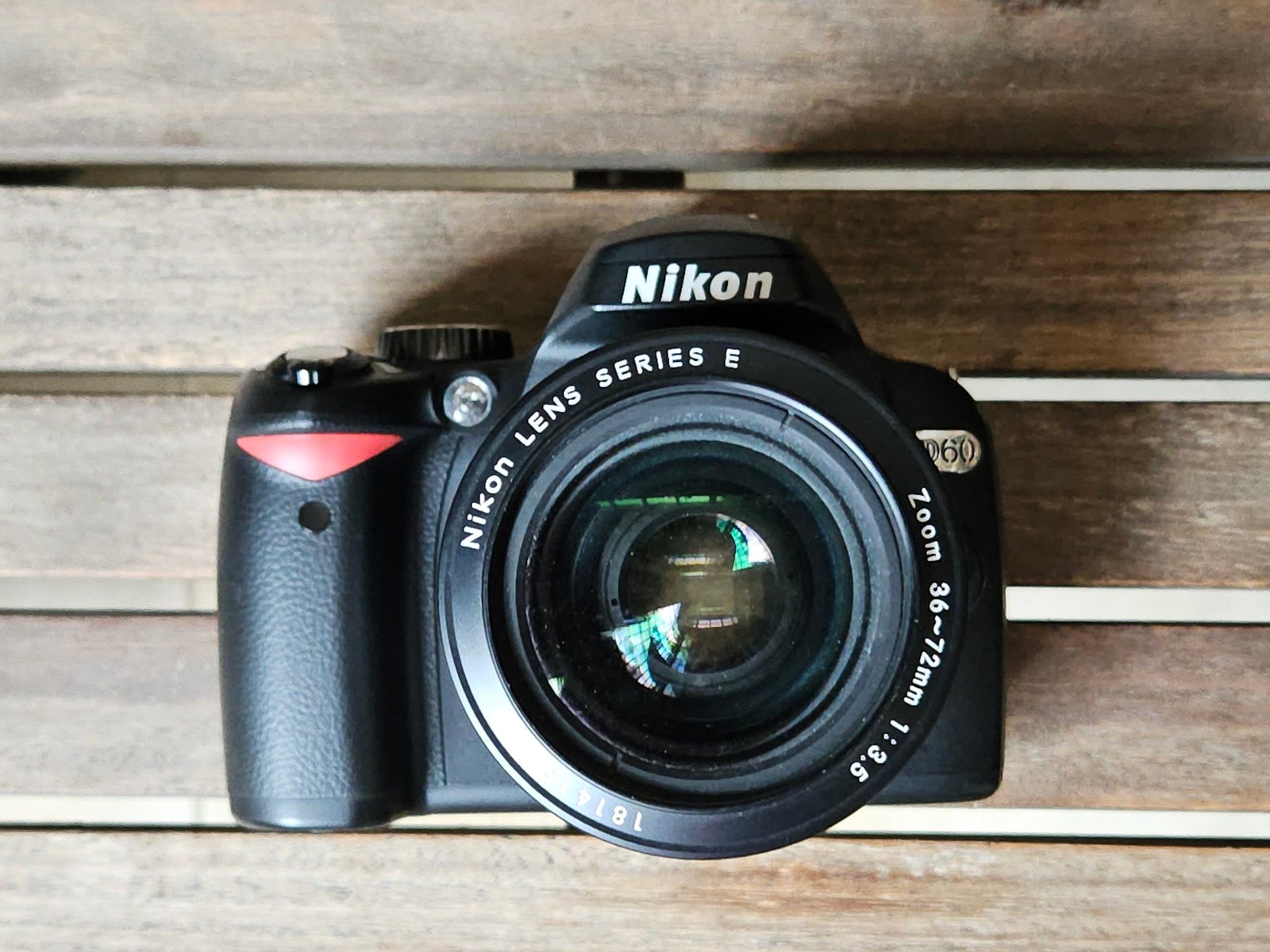
The Nikon D60, released in early 2008, was a pivotal camera for Nikon. It was the successor to the D40x and sat just below the D80 in the lineup. At the time, it was praised for its compact size and ease of use.
But for the past few years through 2025, the landscape of photography has shifted dramatically. We have mirrorless monsters with eye-tracking that can see in the dark, and smartphones that use AI to fake bokeh.
So, why talk about a 10.2-megapixel DSLR from nearly two decades ago?
I recently spent a few weeks shooting with a “minty” Nikon D60 I picked up for a song on the used market. Having used everything from the D3s to the latest Z-mount bodies (Z6, Z7II, Z30, Z50), I wanted to see if this little CCD-sensor camera still had a place in a modern photographer’s bag.
Ergonomics and Build: Small but Mighty

The “Goldilocks” Grip
One thing Nikon has always nailed is ergonomics, and the D60 is no exception. Despite being one of the smallest DSLRs Nikon ever made, the grip is surprisingly deep and comfortable. If you’re used to the beefy D700 (or Z6, Z7 etc) or even a D7000 (or Z30, Z50), the D60 will feel like a toy at first. However, after a long day of street photography, your wrists will thank you.
It’s light enough to carry all day with a prime lens like the 35mm f/1.8G, yet it feels substantially more “serious” than a entry level compact camera or a smartphone.
The top dial is the usual Nikon entry grade dial with all the presets, for me, I use the usual M, A, S, P modes. When using a manual lens, then M mode for sure.

Nikon D60’s pop up flash
There’s nothing special here, the flash is there if you need it in a pinch. Expect the usual washed out colors from photos taken with a direct flash.
Personally, I use on camera flashes as a trigger for my off camera flashes or strobes. I find it more convenient compared to a dedicated trigger and also to keep my gear simpler.
The Viewfinder Experience
Coming from the electronic viewfinders (EVF) of the Z-series (as if you’re not looking at enough screens), looking through the D60’s optical pentamirror viewfinder is a breath of fresh air.
It’s a direct, lag-free view of the world. It’s not as large or bright as the pentaprism in a D300s or better yet the full frame DSLRs, but it’s more than enough for framing.

The 2.5-inch LCD on the back, however, is where the age shows. With only 230k dots, it’s not great for judging critical sharpness, but it’s fine for checking exposure and navigating the simple menus.
Side note: Officially, the D60 was succeeded by the D5000, with an upgraded flip out screen.
The CCD Sensor: The Secret Sauce

The main reason anyone buys a Nikon D60 in 2025 is the 10.2MP CCD sensor. Most modern cameras use CMOS sensors, which are better for high ISO and video. But many enthusiasts swear by the “CCD look”, a certain film-like quality to the colors and a unique way it handles skin tones and highlights.
Can you try to replicate this look in Lightroom or Photoshop? Sure. Will it be potentially more work for you. Yes.
In this regard, the D60’s color science should help you out.
Color Science

In good light, the D60 produces images that are punchy and vibrant right out of the camera. There’s a “thickness” to the colors that I sometimes find lacking in modern CMOS files. If you shoot RAW (NEF), you’ll find that the files are very malleable at base ISO (200).
ISO Performance (The Trade-off)
Here is the reality check: the D60 is a “fair weather” camera.

•ISO 200: Reasonably clean and detailed. No issues using this image.

•ISO 400-800: Noticeable grain, but it looks more like film grain than digital noise. Noise artefacts are noticeable and needs work.

•ISO 1600: Extensive noise in the shadows, loss of detail. In the sky, there is an ugly red line stretching horizontally. Acceptable in small sizes but needs alot of denoising work.

•ISO 3200 (Hi 1): Use only in emergencies. You can see the image is has noise everywhere, with patterns and the ugly horizontal red line getting worse.
Unlike the modern cameras (like the Z series cameras), the D60 is not ISO invariant. If you underexpose a shot and try to “push” it 3 stops in Lightroom, you’re going to see a lot of ugly noise and color shifting. My advice? Get it right in the camera, use the semi auto modes like A and S for the right exposure settings and stick to well-lit environments. For night shots, use a flash or a tripod.
Autofocus: Three Points of… Simplicity?

The Nikon D60 features a 3-point AF system. Yes, you read that right. Just three.
In an era where we have hundreds of AF points covering the entire frame, 3 points feels incredibly restrictive. However, it forces you to slow down. I found myself using the “focus and recompose” technique almost exclusively. It’s not a camera for tracking fast-moving birds or erratic toddlers, but for portraits, landscapes, and still life, it gets the job done.
Note on Lenses: The D60 does not have an internal focus motor. This means it will only autofocus with AF-S or AF-P lenses. If you mount an older AF-D lens, you’ll be focusing manually. While this might seem like a drawback, it’s a great way to learn the fundamentals of manual focus!
Image Quality: 10 Megapixels is Enough
“Only 10 megapixels?” you might ask.
Unless you are printing billboards, 10MP is plenty. For Instagram, Facebook, and even A4-sized prints, the D60 delivers more than enough detail. The lower pixel density actually makes the images look very “smooth” and less clinical than the 45MP monsters of today.
One personal anecdote: I took the D60 to a local park for some macro shots of flowers. Pairing it with an old manual focus Micro-Nikkor lens, the results were really quite good (for an old camera). The way the CCD sensor rendered the greens and reds was something my Z6 struggled to replicate without significant post-processing.
Pricing in 2026

This is an old camera after all, so the pricing will naturally be quite low. A well used unit can be had for between $60 to $100, with a kit lens as well, if you’re lucky.
The fact that it was an entry level camera should also help lower pricing and help negotiations, though there was a surge in demand for cameras with CCD sensors due to social media.
Nikon D60 in 2025: Who is it for?
Is the Nikon D60 still a good buy in 2025?
Yes, if:
•You are a student or beginner on a tight budget (you can find these for under SG$150 with a kit lens).
•You want to experience the “CCD magic” without spending a fortune on a Leica M9.
•You want a simple, “back to basics” photography experience.
No, if:
•You need to shoot video (the D60 has no video mode).
•You do a lot of low-light or indoor photography without a flash.
•You need fast, reliable tracking autofocus.
Best Lenses for the Nikon D60
Any of the 18-55mm kit lenses – small, compact, cheap and sharp enough.
If you can find it, the older 18-70mm kit lens.
Small manual lenses if you don’t mind or like manual focus
Nikon 35mm f/1.8G DX – small, cheap and sharp. Being a prime lens, gives you bokeh when the background is far enough.
Nikon 50mm f1.8G – small, cheap and sharp. Being a prime lens, gives you bokeh when the background is far enough. One issue compared to the 35mm is that it might be a little too “zoomed in” when you shoot landscape, but you can learn photo composition with this limitation.
Conclusion
The Nikon D60 is a reminder of a simpler time in digital photography. It doesn’t have Wi-Fi, it doesn’t have 4K, and it won’t track a bird’s eye from a mile away. But what it does do is take beautiful, soulful (with it’s own quirk) photographs if you give it enough light.
If you can find one in good condition for a low price, go for it. It’s a fantastic “second camera” or a dedicated tool for when you want that specific CCD look.
I also talk about other classic DSLRs like the Nikon D7000 and the Nikon D300s.
Leave a Reply