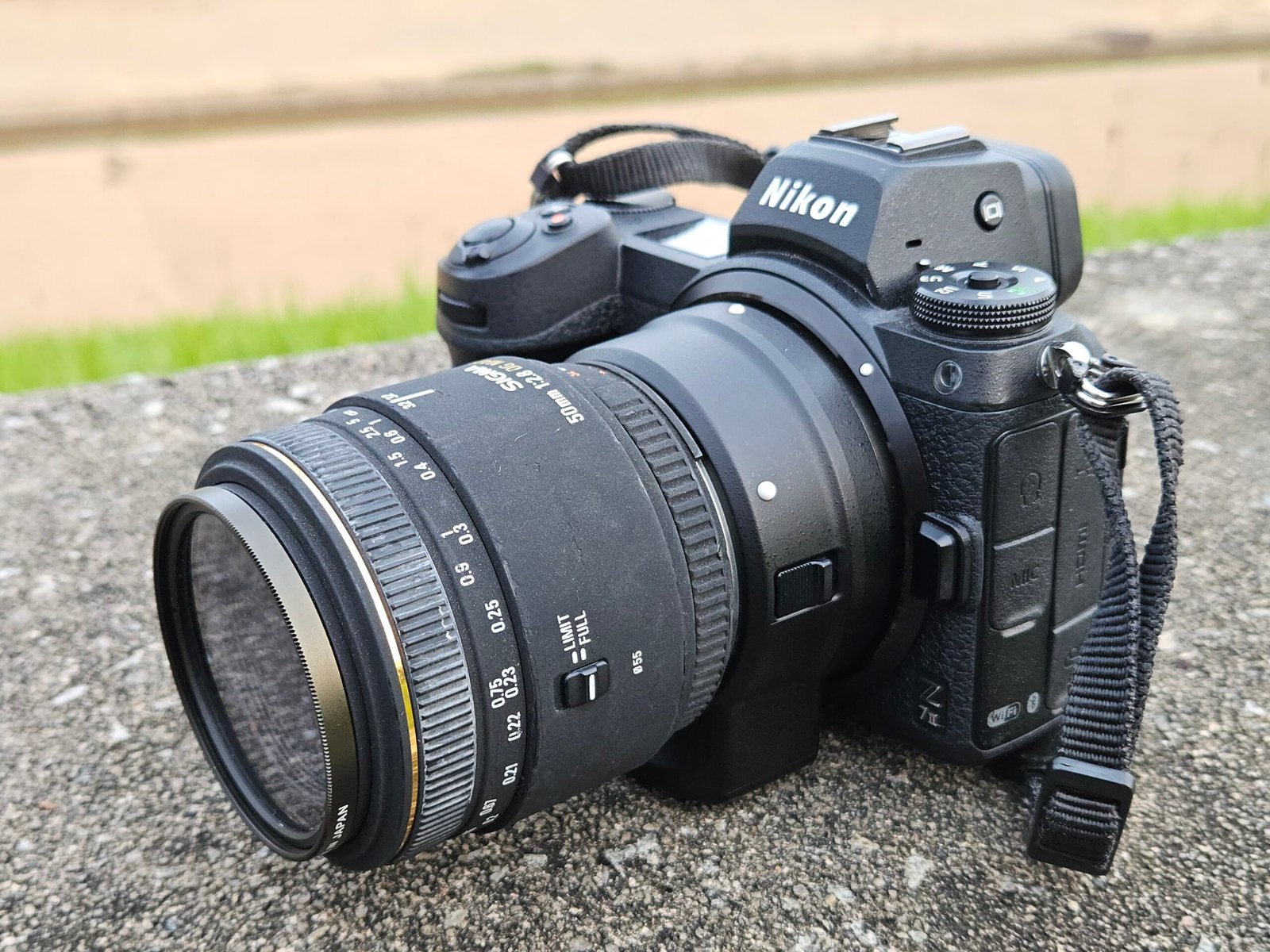
The Hidden Gem in the Used Market
Why spend SG$800+ on a modern mirrorless macro lens when you can get true 1:1 magnification for under SG$150? In the world of photography, we often get caught up in the “latest and greatest” hype, but the used market is full of “sleeper” lenses that can still trade blows with modern glass.
The Sigma 50mm f/2.8 EX DG Macro is exactly that, a hidden gem that many photographers overlook because it doesn’t have a fancy “Z” badge.
I’ll be honest: I found my copy via the used item marketplace in Singapore called Carousell. I had been looking for a cheap and cheerful Macro lens that I can use for random walkarounds. It used to be for my D750 but now I have started using it on my Nikon Z7II.
After years of random use, I recently dug it out again for my Z mount cameras. On the Z full frame cameras, this lens isn’t just “good for the price”, it is legitimately one of the sharpest 50mm lenses you can get for under $100.

Whether you’re a student on a budget or a pro looking for a dedicated product photography tool, this small Sigma lens deserves a spot in your bag.
Build Quality & Ergonomics: Old School Sigma “EX” Standard
The “EX” in Sigma-speak stands for “Excellence,” and back in the day, this was their professional line, the equivalent of Nikon’s “Gold Ring” or Canon’s “L” series. The build quality reflects that. It’s a dense, solid little lens that feels like it could withstand some knocks (though I don’t recommend testing that theory).
The “EX” Finish

Most copies of this lens feature Sigma’s classic matte crinkle finish. While it has a unique look (can be good or bad depending on preference) and provides a great grip, be aware that on some older units, this coating can become “sticky” over time due to humidity. I’ve heard of some users in the past finding ways to scrape it off!
The Extending Barrel

Unlike modern internal-focusing lenses, the Sigma 50mm uses a “telescoping” design. As you focus closer toward 1:1 magnification, the inner barrel extends significantly—almost doubling the length of the lens.
This is important to keep in mind for your working distance. At 1:1, the front of the lens is only about 2 inches away from your subject. If you’re shooting skittish insects, you’ll need to be very stealthy!
Focus Limiter Switch

On the side of the barrel, you’ll find a “Full/Limit” switch. This is a lifesaver. Because macro lenses have such a long focus throw, they can “hunt” if they miss focus.
Setting the switch to “Limit” prevents the lens from searching through the entire macro range when you’re just using it as a standard 50mm prime for street or portraits.
The “DG” Difference: Versions Explained
If you’re hunting for this lens on Carousell or eBay, you’ll see a few different versions. It’s important to know which one you’re getting.
•The Non-DG Version: The older “EX” version was designed primarily for film cameras.
•The DG Version: The “DG” (Digital Grade) version is the one you want. It features updated optical coatings on the rear elements to reduce “ghosting” and flare caused by light reflecting off digital sensors. In my experience, the DG version handles shooting against the sun much better.
The Compatibility Catch (Nikon Users)
For my fellow Nikon shooters, there is one major caveat: this lens does not have an internal autofocus motor. It relies on the “screwdriver” motor inside the camera body.
•Will Autofocus on: D70, D80, D90, D200, D300, D7000 series, D600, D700, D800, etc.
•Manual Focus Only on: D40, D60, D3000 series, D5000 series.
If you’re using a Nikon Z mirrorless camera with the FTZ adapter, it will also be manual focus only. However, with focus peaking, manual focusing this lens is actually quite manageable.
Image Suggestion: A close-up shot of the lens mount showing the small “screwdriver” AF pin. Also, highlight the “DG” logo on the side of the barrel so readers know exactly what to look for when buying used.
Optical Performance: Sharpness That Bites
This is where the Sigma 50mm f/2.8 Macro truly earns its legendary status. Macro lenses are designed for flat-field sharpness, and this lens is a prime example of that.
Center and Corner Sharpness

Wide open at f/2.8, the center sharpness is very good. As with many macro lenses, this Sigma 50mm is sharp enough that it can actually be “unforgiving” for portraits, revealing imperfections on a subject’s skin. In shots like this, corner sharpness is irrelevant since you’re focusing on the subject in or near the centre anyway.

By f/5.6, the lens delivers much better detail but not corner-to-corner sharpness, surprisingly. When zoomed in, I can still see some blurriness in the leaves. I was also pretty sure this is not caused by motion from the wind. Maybe the lack of corner to corner sharpness is because of the age of the lens as compared to a sensor.
Macro Capabilities

This is a “true” macro lens, meaning it reaches 1:1 magnification without the need for extension tubes or close-up filters. At 1:1, a tiny object like a grain of rice will fill the entire sensor. The level of detail it can resolve, the scales on a butterfly’s wing or the micro-printing on a dollar bill, is simply incredible.
Bokeh and Color

Despite its clinical sharpness, the bokeh (out-of-focus areas) is surprisingly pleasant. With its 7-blade diaphragm, the background blur is smooth and non-distracting, making it a very capable portrait lens on a DX (APS-C) body, where it acts like a 75mm equivalent. There is excellent contrast thanks to those DG coatings.
5. Real-World Usage: Not Just for Bugs
While the Sigma 50mm f/2.8 EX DG Macro is undeniably a macro specialist, its 50mm focal length (75mm equivalent on APS-C/DX cameras) makes it surprisingly versatile.
It’s not a one-trick pony; it can easily pull double duty as a standard prime lens for a variety of photographic genres.
The 50mm Focal Length: A Versatile Prime
On a full-frame camera, 50mm is often considered the “nifty fifty”—a classic focal length that closely mimics human vision. This makes the Sigma 50mm an excellent choice for street photography, environmental portraits, or even general walk-around shooting.

Its f/2.8 aperture, while not as fast as some f/1.8 or f/1.4 primes, still provides good low-light performance and pleasing subject separation. On an APS-C body, it becomes a short telephoto, ideal for headshots or isolating details in a scene.
Working Distance Challenges
One of the inherent challenges of macro photography, especially with a 50mm macro lens, is the working distance. As mentioned earlier, to achieve 1:1 magnification, the front of the lens needs to be mere inches from your subject.
This can create several practical difficulties:
•Lighting: It’s hard to get light onto your subject without the lens casting a shadow.
•Subject Interaction: Live subjects like insects can be easily startled.
•Depth of Field: At such close distances, the depth of field is razor-thin, requiring precise focusing and often focus stacking for fully sharp images.
However, these challenges also force you to be more creative and deliberate with your shots, which can be a rewarding learning experience.
Autofocus Speed: Managing Expectations
Let’s be clear: this is not a sports lens. The autofocus, driven by the camera’s internal motor, is not fast by modern standards. It can be noisy, and in low light or against low-contrast subjects, it may “hunt” before locking focus.
For macro work, most photographers will switch to manual focus anyway, using live view and focus peaking for critical sharpness. For general photography, it’s adequate for static or slow-moving subjects, but don’t expect it to track a bird in flight.
•Image Suggestion: A “lifestyle” or street photography shot taken in a local Singapore spot (like Haji Lane or a wet market) to show its versatility as a 50mm prime.
6. Sigma 50mm Macro vs. Nikon 50mm S f/1.8
If you are in the market for a 50mm for your Nikon Z Mount body, you could do worse than this lens. I have done a rough check on the Singapore used and international market in 2026, below.
Sigma 50mm Macro Price in 2026

In Singapore, the price of the Sigma 50mm Macro ranges from S$68 to about $150. Prices will vary by condition of course.

From a google search, prices are from US$60 and up. Regardless, this is a budget friendly lens, especially on the used market.
Logically, one could be going for a Z mount lens like the 50mm 1.8 S or the 50mm 1.4. Pricing wise, they will likely be going for about SG$600-700.

Alternatively, you could always look for other 3rd party Z mount lenses like the ones from Meike or Viltrox. But since I don’t own any, I cannot comment on them too much.
7. Conclusion: Should You Buy It in 2026?
•Final Verdict: Who is this lens for? (Budget macro enthusiasts, product photographers).
•Pros & Cons Summary Table.
•Closing Thought: It’s a lens that forces you to slow down and appreciate the small things.
•Image Suggestion: A final “moody” shot of the lens with its hood on, looking professional and ready for work.
PS.
I also talk about other classic lenses like the Nikon AF-S 300mm f/4D. For another old lens, check out the Nikkor 200mm Q.C. f/4 or the vintage zoom Nikon Series E 36-70mm f/3.5.
Leave a Reply