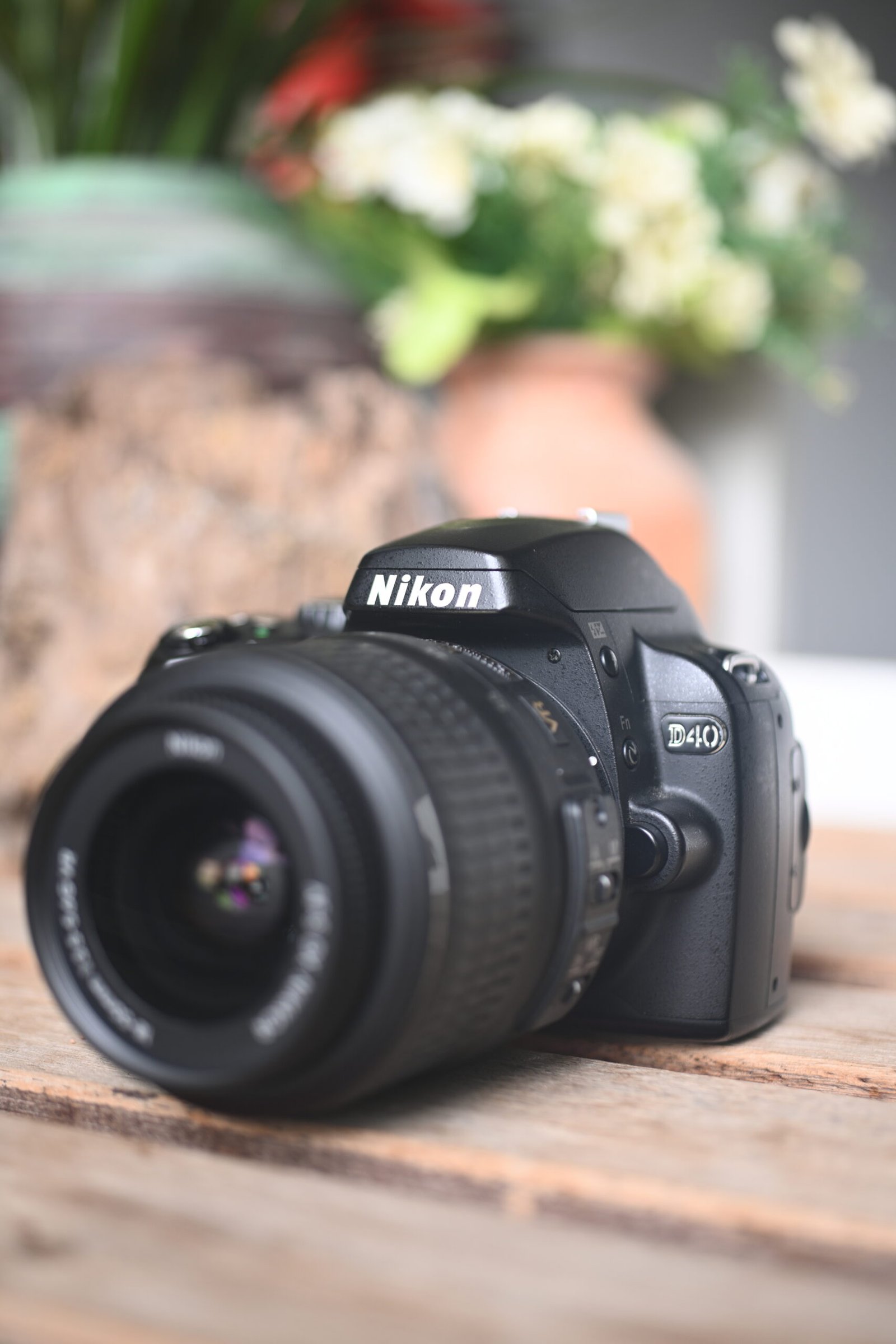
If you told a “serious” photographer in 2006 that people would still be hunting for the Nikon D40 in 2025, they would have laughed you out of the studio. At the time, the D40 was Nikon’s most “crippled” DSLR, it only had 6.1 megapixels, just three autofocus points, and no internal focus motor. It was the definition of an entry-level camera.
Fast forward nearly two decades, and the Nikon D40 has achieved a cult-like status. While modern mirrorless cameras are fighting a war over eye-tracking AF and 8K video, a growing community of photographers is returning to this humble plastic DSLR.
Why? Because the Nikon D40 has a “soul” that modern cameras often lack. After spending a month revisiting one of the earliest entry level cameras, I’ve realized that its limitations are actually its greatest strengths.
Nikon D40 Specs
Nikon D40 –> Key Specifications
| Release date | December 2006 |
| Sensor type | APS-C CCD (DX format) |
| Sensor size | 23.7 × 15.5 mm |
| Effective megapixels | 6.1 MP (3,008 × 2,000 px) |
| ISO range | ISO 200–1600, expandable to ISO 3200 (Hi-1) |
| Autofocus points | 3-point TTL phase-detection AF |
| Autofocus note | No in-body AF motor — requires AF-S / AF-I lenses for autofocus |
| Shutter speed range | 30s to 1/4000s + Bulb |
| Flash sync speed | 1/500s — fastest among entry-level DSLRs of its era |
| Built-in flash | Yes (pop-up, GN12 at ISO 100) |
| Continuous shooting | 2.5 fps |
| Body weight | 475g (without battery) / 522g (with battery + card) |
| Dimensions | 124 × 94 × 64 mm |
| Viewfinder | Optical pentamirror, ~0.75× magnification |
| LCD screen | 2.5-inch, 230,000 dots, fixed |
| Storage | SD / SDHC card |
| File formats | JPEG + NEF (12-bit RAW) |
| Video recording | No video capability |
| Lens mount | Nikon F-mount |
| Successor | Nikon D3000 |
The 6.1MP CCD Sensor: Why Less is More
The heart of the Nikon D40 is its 6.1-megapixel CCD sensor. In an era where even budget smartphones boast 50MP, 6.1MP sounds like a joke. But here’s the secret: those 6 million pixels are huge.

The “CCD Magic”
Most modern cameras use CMOS sensors. They are faster and better at high ISO, but many enthusiasts argue they look “clinical.” The D40’s CCD sensor produces colors that feel more like film. There’s a richness to the skin tones and a specific way it handles blues and greens that just feels right.

When I took the D40 out for a walk around my neighbourhood, the images had a punchy, organic quality. At base ISO 200, the files are remarkably clean. And because the resolution is low, the files are tiny. You can edit them on a 10-year-old laptop without a hitch, and they still look fantastic on a 4K monitor or Instagram.

ISO Performance: Know Your Limits
The D40 is not a low-light beast. Don’t expect much from a 20 year old DSLR. Still, as you can see from the shots below, much of the usual daytime range of ISOs between 200-1600 are still very much useable.


•ISO 200-400: No issues whatsoever.

•ISO 500-800: Usable, with a nice film-like grain.

Between 800-1500: Useable shot depending on personal preference, noise is visible.


•ISO 1600 (and HI-1): Things get messy with more noise and loss of detail.
If you’re shooting in 2025, treat the D40 like you’re shooting ISO 400 film. I personally would use it to 1600, especially shot at RAW and with modern denoising software. Otherwise, if the sun goes down, reach for a flash or a tripod.
The Secret Weapon: 1/500s Flash Sync
Here is something that even the $6,000 Nikon Z9 can’t do natively: sync with a flash at 1/500th of a second.
Because the D40 uses a hybrid electronic/mechanical shutter, it can sync with external flashes at incredibly high speeds. For strobists and portrait photographers, this is a game-changer. It allows you to overpower the afternoon sun with a small, cheap speedlight without needing expensive High-Speed Sync (HSS) gear.
I paired the D40 with a cheap manual trigger from YongNuo and an old Yongnuo 560 Mark IV flash. The ability to kill the ambient light at 1/500s while keeping the aperture wide open at f/1.8 is lovely. This feature alone makes the D40 worth the SG80-100 it costs on the used market.

The pop up flash works in a pinch, especially for night shots when you can’t really use high ISO. You can also use it for simple external flash triggering.
How the Nikon D40 handles: Perspectives from 2026

The D40 was Nikon’s smallest DSLR for a long time, and it still feels great today. It’s light enough to be a “carry everywhere” camera. The grip is surprisingly deep for its size, and the button layout is refreshingly simple.
There are no complicated menus to get lost in. You have a dial for your modes, a few buttons for the essentials, and that’s it. It forces you to focus on the three pillars of photography: Aperture, Shutter Speed, and ISO.
The Viewfinder

It’s an optical viewfinder (OVF). It’s small and a bit “tunnel-like” compared to a D700, but it’s bright and lag-free. There’s something deeply satisfying about seeing the world through actual glass rather than a tiny television screen (EVF).
The LCD screen is ok for checking shots, and images for review come up in a reasonable time on a faster card (even the simple class 10 SD cards will do).

Given this is really a simple point and shoot DSLR, the controls are also simple.

There is only 1 card slot for an SD card. Gets the job done for an entry level DSLR. Even the Nikon Z50 has only one slot anyway.
The “Crippled” Lens Mount: A Blessing in Disguise?
The D40 famously lacked an internal focus motor. This meant it wouldn’t autofocus with older AF and AF-D lenses. In 2006, this was a huge deal. In 2025, it’s irrelevant.
Nikon has since released dozens of incredible AF-S and AF-P lenses that work perfectly on the D40. The 35mm f/1.8G DX is the perfect partner for this camera, it’s sharp, cheap, and balances beautifully.

Pro Tip: If you want to really lean into the “vintage” feel, mount an old manual focus AI-S lens such as the Nikon Series E 36-72mm. The D40 won’t meter with them (you’ll have to use the “sunny 16” rule or guess and check the LCD), but it’s a fantastic way to learn the craft.
Best Lenses for the Nikon D40
Any of the 18-55mm kit lenses – small, compact, cheap and sharp enough.
If you can find it, the older 18-70mm kit lens.
Small manual lenses if you don’t mind or like manual focus
Nikon 35mm f/1.8G DX – small, cheap and sharp. Being a prime lens, gives you bokeh when the background is far enough.
Nikon 50mm f1.8G – small, cheap and sharp. Being a prime lens, gives you bokeh when the background is far enough. One issue compared to the 35mm is that it might be a little too “zoomed in” when you shoot landscape, but you can learn photo composition with this limitation.
Price of the Nikon D40 in 2026

If you are in Singapore, you will likely get the camera from Carousell. A quick check from Carousell shows most listings selling the body and a kit lens for about $100-$145.IMO, anything more is a ripoff since it’s really quite an old camera. Also, be careful of the LCD screening failing (if you start to see dark edges around the screen).

Surprisingly, we can also find it pre-owned on Shopee, an Amazon competitor (for readers not based in Southeast Asia). Again, if it comes with a lens, then the pricing of around $150 is fair, but any more can be considered a mark up.
Check out this article on where you can get used gear in Singapore.
Nikon D40 –> Frequently Asked Questions
No, the Nikon D40 does not shoot video. It is a stills-only camera with no video recording capability. Released in 2006, video on DSLRs was not yet a feature, Nikon’s first video-capable DSLR was the D90, launched in 2008. If you need video, consider the Nikon D5000 or any model released from 2008 onwards. For a modern used option with video, the Nikon Z30 is worth considering.
The Nikon D40 has 6.1 effective megapixels, produced by an APS-C CCD sensor at a maximum resolution of 3,008 × 2,000 pixels. In 2026, that sounds low, but each pixel is large relative to the sensor size, which is why the D40 produces clean, film-like images at ISO 200–400. For Instagram, web use, and prints up to around 12 × 8 inches at high quality, 6.1 MP is entirely sufficient.
The Nikon D40 uses an APS-C CCD sensor measuring 23.7 × 15.5 mm, also known as Nikon DX format, with a 1.5× crop factor. The sensor type is CCD (not CMOS like most modern cameras), which is responsible for the camera’s distinctive colour rendering, often described as warmer and more film-like than contemporary CMOS sensors.
Yes, for the right use cases, the Nikon D40 is still a genuinely good camera in 2026. It excels as a learning camera for beginners wanting to shoot manual, as a lightweight street camera, and as a CCD “film-look” body. Its 1/500s flash sync speed is still faster than most cameras sold today. It is not a good choice if you need video, reliable high-ISO above 800, or heavy cropping. In Singapore, a body with kit lens typically runs SG$80–150 on Carousell, making it one of the most affordable ways into DSLR photography in 2026.
The Nikon D40 syncs with flash at 1/500s, faster than most DSLRs and mirrorless cameras released since, including current full-frame bodies which typically max at 1/200–1/250s. This allows the D40 to overpower bright ambient light with a small speedlight without needing High-Speed Sync (HSS) gear. For outdoor portrait and strobist photographers, this remains one of the most compelling reasons to use a D40 in 2026.
The Nikon D40 autofocuses only with AF-S and AF-I lenses since it has no internal AF motor. Older screw-drive AF and AF-D lenses work in manual focus only. Best options in 2026: the Nikon 35mm f/1.8G DX (sharp, compact, ideal on DX), the Nikon 50mm f/1.8G (portraits), and the 18-55mm AF-S kit lens. Third-party AF-S lenses from Sigma and Tamron also work normally.
Nikon D40 in 2025: Is it Still Relevant?
Is a 6MP camera from 2006 still a good buy?
Absolutely, if:
•You are a student on a budget: It is the ultimate “learning” camera. It won’t do the work for you; you have to learn how light works.
•You are a “CCD Hunter”: You want that specific color science without paying Leica prices.
•You are a Strobist: You want that 1/500s sync speed for outdoor portraits.
•You are on a budget: You can often find these for the price of a fancy dinner (SG$50-100).
Skip it if:
•You need to crop heavily.
•You need to shoot video (it doesn’t have any).
•You need to shoot in near-darkness without a flash.
Conclusion
The Nikon D40 is a reminder that photography isn’t about specs; it’s about the image. In 2025, it stands as a “modern classic.” It’s a camera that gets out of your way and lets you enjoy the process of making pictures.
If you see one sitting in a second-hand shop or on Carousell for a low price, buy it. Even if you own a Z8 or a Sony A7R V, the D40 will give you a different perspective on your photography. It’s a 6-megapixel wonder that still has plenty of magic left.
Check out the older brother D70s. I also talk about its successor, the Nikon D60, the Nikon D5000 and the more advanced Nikon D7000.
Check out the Nikkor Q.C 200mm f/4 for another vintage lens you can use with the D40.
Leave a Reply