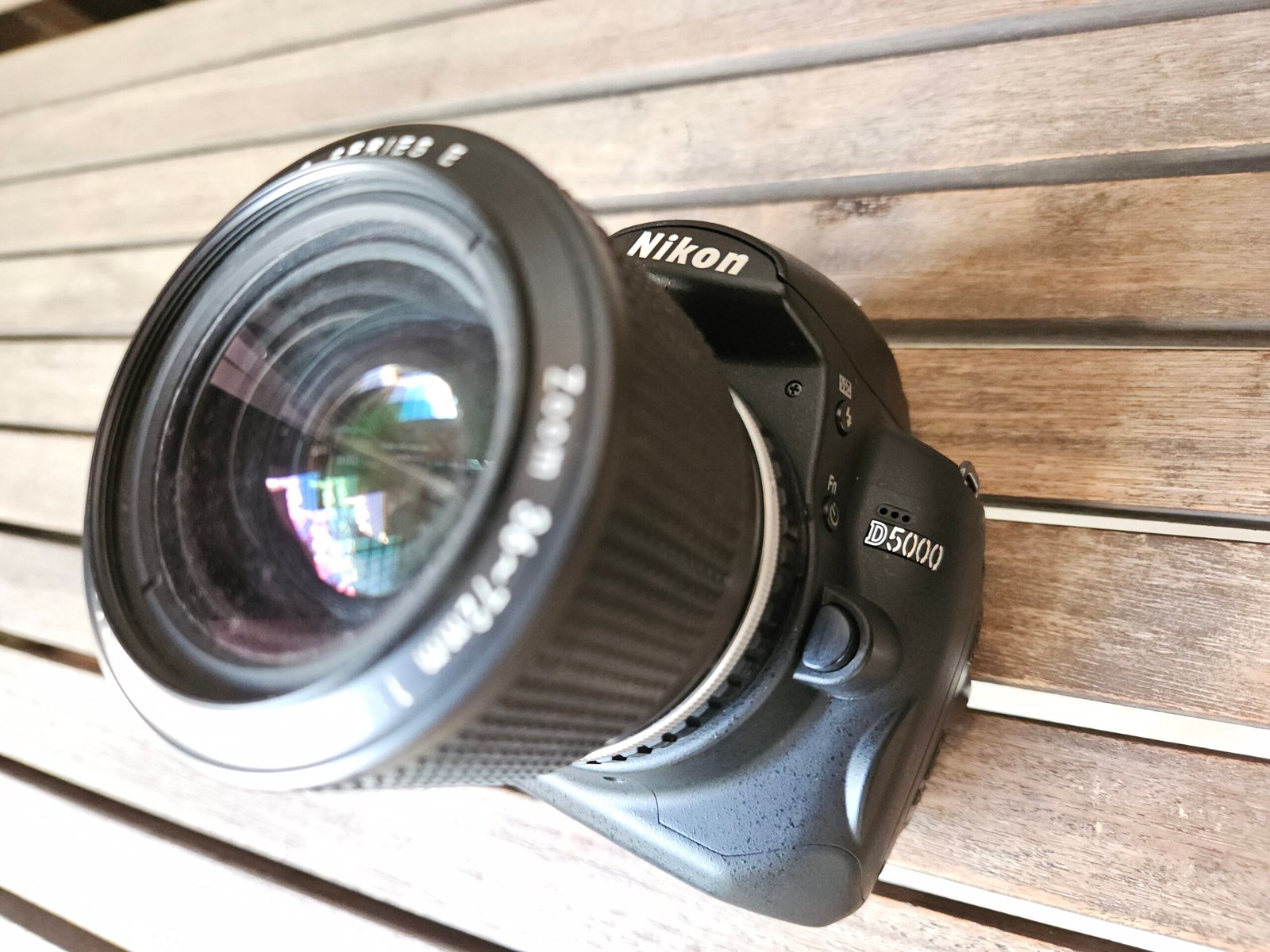
In the grand timeline of Nikon DSLRs, the Nikon D5000 occupies a very special place. Released in 2009, it was the first Nikon DSLR to feature an articulating (flip-out) LCD screen. At the time, purists scoffed at it, calling it a “gimmick” for amateurs.
Fast forward to 2025, and almost every modern mirrorless camera, from the vlogging-focused Z30 to the professional Z9, owes a debt to this little pioneer. But beyond the screen, the D5000 was also a “wolf in sheep’s clothing,” packing the same legendary 12.3MP sensor found in the much more expensive Nikon D90 and D300.
I recently picked up a well-loved D5000 to see if this “D90-lite” still holds up in the age of 4K video and AI autofocus.
The “D90-Lite” Sensor: 12.3MP of Pure Quality (in 2009)

The biggest selling point of the D5000, both then and now, is its sensor. It uses the same 12.3-megapixel CMOS sensor that made the D90 and the D300 a legend.
Image Quality and Color

In 2025, 12 megapixels might seem low, but as I’ve said before, it’s the quality of those pixels that matters. The D5000 produces images with excellent dynamic range and very pleasing color science. Unlike the CCD sensors in the Nikon D40 or D60, this is a CMOS sensor, which means it handles higher ISOs much better.
I took the D5000 for a night walk around Marina Bay. Even at ISO 1600, the noise is well-controlled and has a “grainy” rather than “digital” look. If you’re shooting for social media or small prints, the 12.3MP files are more than enough.
ISO Performance

•ISO 200-800: Clean and detailed enough for printing and social media

•ISO 1600: Very usable with minor post-processing, especially with post 2025 de-noising software.

•ISO 3200 (Hi-1): Pushing it, but okay for “documentary” style shots. Potentially ok for phones and social media use.
The Articulating Screen: A Game Changer for 2009

The D5000’s screen was revolutionary. Unlike (most) modern screens that flip out to the side, the D5000’s screen flips down. We still had a flip down screen even til the Nikon Z50 I.
The Good
This design is useful for overhead shots (like shooting over a crowd at an event) or waist-level street photography. It allows you to be more discreet, looking down at the camera rather than holding it up to your eye. It’s also great for macro work, allowing you to get low to the ground without having to lie in the mud.
The Bad
Because it flips down, you can’t use it easily on a tripod, as the tripod head will block the screen. Also, by 2025 standards, the screen resolution is quite low (230k dots). It’s fine for framing, but don’t rely on it to judge critical sharpness, you’ll want to zoom in to check your focus. Even zooming in on the screen isn’t that great here.
Side note: The predecessor, the D60, didn’t have a flip out screen and had weak overall specs. It did have a CCD sensor, however. Some people prefer the CCD look, if you will.
Ergonomics and Build: Compact and Capable
The D5000 sits right between the tiny D3000 series and the beefier D90 (thereafter the D7000 series). It’s compact enough to be a travel camera but has enough “heft” to feel like a serious tool.
Handling

The grip is comfortable (for small to average hands), though a bit smaller than the Nikon D7000. One thing to note is that, like the D40 and D60, the D5000 does not have an internal focus motor. You’ll need AF-S or AF-P lenses to get autofocus.
Note the SD card slot on the right of the camera on the grip. This has only a single card slot. Simple.

As with many Nikon cameras, the controls are familiar, with the control dial on the right side for beginner friendly cameras. I personally just used MASP modes and didn’t bother with the presets. Even after so many years, the buttons on the camera worked well.

If you look at the image above, on the left of the camera, there are 2 buttons. The top button is for the pop up flash, handy when you’re shooting in an area with little light and you just need something for the photo. The bottom button is a customisable function button that you can use for different functions. Personally, I set it to ISO for easier control on the fly. These have been implemented from the previous cameras and continue to be used in future cameras even until the D5600 released in 2016.

I would recommend pairing it with the Nikon 18-55mm VR kit lens and the 35mm f/1.8G (or any other small lens for the matter). The balance was perfect. It’s a setup that you can carry all day without feeling like you’ve been to the gym.
Video: The 720p Time Capsule
The D5000 was one of the first DSLRs to offer video (D-Movie). However, in 2025 and beyond, this is where the camera shows its age the most.
•Resolution: 720p HD (not 1080p or 4K). This is the main downer, but you can at least record something in a pinch. But honestly, even your phone will be way better than this.
•Focus: No autofocus during video. You have to focus manually. Not a problem for people with experience, though many have been spoilt in recent years by the fast Autofocus in modern cameras and face detection functions.
•Audio: Mono internal microphone only (the in built mic isn’t the best for audio capture as well); no external mic jack.
If you’re looking for a vlogging camera in 2026, this isn’t it. But if you want to capture short, “vintage-looking” clips for a nostalgic reel, the 720p footage has a certain charm to it.
Pricing in 2026

The D5000 was never an expensive camera even when it was first released in 2009. After 16+ years, you can get it even with a kit lens for SG$100 or less.
Best Lenses for the Nikon D5000
Any of the 18-55mm kit lenses – small, compact, cheap and sharp enough.
If you can find it, the older 18-70mm kit lens.
Small manual lenses if you don’t mind or like manual focus
Nikon 35mm f/1.8G DX – small, cheap and sharp. Being a prime lens, gives you bokeh when the background is far enough.
Nikon 50mm f1.8G – small, cheap and sharp. Being a prime lens, gives you bokeh when the background is far enough. One issue compared to the 35mm is that it might be a little too “zoomed in” when you shoot landscape, but you can learn photo composition with this limitation.
Nikon D5000 in 2025: Who is it for?
Is the Nikon D5000 still a good buy in 2025?
Yes, if:
•You are a beginner on a budget: You get a DSLR with a large sensor for learning photography cheaply (potentially under $100).
•You love low-angle or macro photography: The articulating screen is a lifesaver.
•You want a “beater” camera: Something you can take to the beach or on a hike without worrying about your expensive mirrorless gear.
No, if:
•You need video: The 720p limit and lack of mic jack are dealbreakers for modern creators (why are you using this for content creation in 2026).
•You use a tripod constantly: The bottom-hinged screen is frustrating for tripod use.
•You need fast tracking AF: The 11-point AF system is reliable but not built for fast action.
Conclusion
The Nikon D5000 is a fantastic entry point into the world of Nikon DSLRs. It offers a perfect balance of “old school” charm and “modern” convenience. While it lacks the CCD magic of the D40, it makes up for it with a much more versatile CMOS sensor and that handy flip screen.
If you can find one in good condition (check the screen hinge!) for under SG$100, it’s a steal. It’s a camera that will teach you the fundamentals while still delivering images that can hold their own in 2025.
I also talk about its more advanced cousin, the Nikon D7000, and other old semi professional cameras like D100, D200 and D300.
Leave a Reply